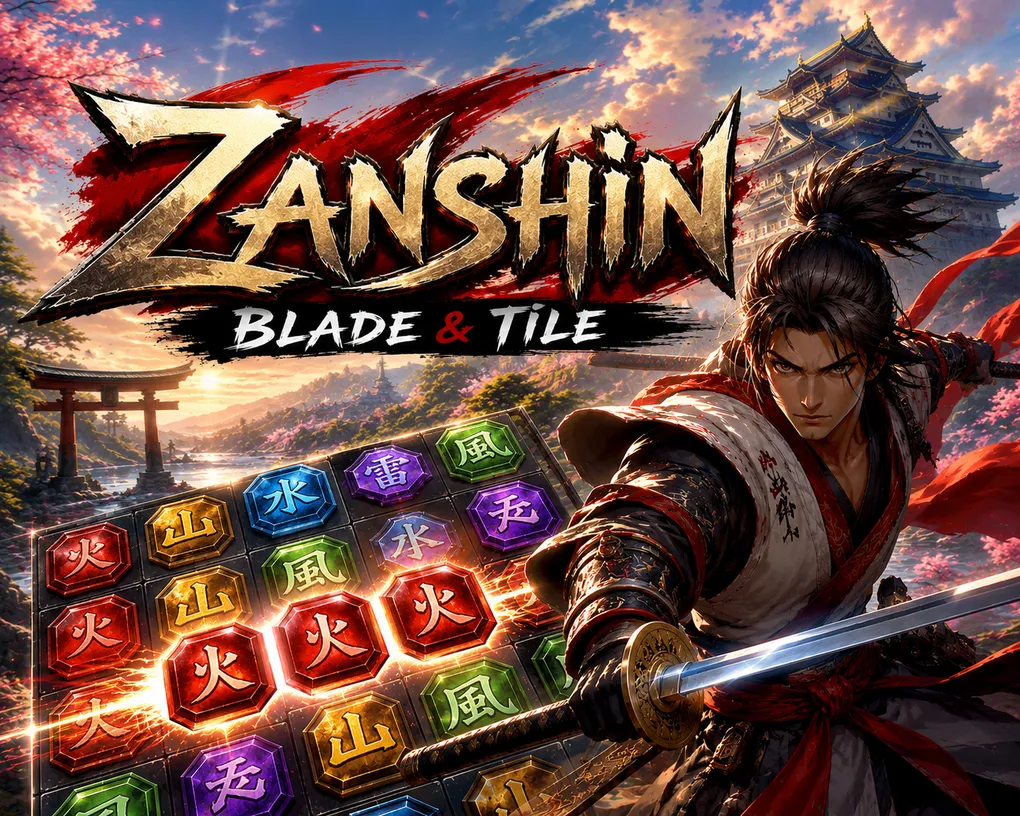
Candy Crush meets Legend of Legaia's Arts System | Zanshin: Blade & Tile
Some people consider match-3 games cozy, calm. I want to challenge that notion with face-breaking martial arts action. Introducing Zanshin: Blade & Tile, a match-3 meets martial arts action game hybrid!
Match-3 puzzler PLUS action game? Now… why would any sane person think to mash these two concepts together? For one, mashups were hot… oh I don’t know… 5 years ago? Two, puzzlers and action games tend to look and feel completely different from one another - how can these two concepts be made to feel cohesive and complementary?
Well, my answer here is a mashup of its own - partly borne from one of the first games I ever called my favorite of all time, and the second piece from my mom. No for reals, I mean that. Hang with me for a minute.
I’ve loved games all my life, and as young as 3 or 4 I remember holding an Atari 2600 game controller. I doubt I was doing anything productive with the controller, but the memory sticks. Maybe the joystick just felt like a toy to me, or maybe it was the fact that I saw my older siblings glued to the TV with the same level of fascination as I was to the controller. Either way, I knew I was hooked.
So I’ve always loved games - but when I was around middle school, my future brother-in-law brought over this massive binder of disks - and a suitcase with one of the greatest gaming consoles ever invented - the PS1. The only other times I had seen a PlayStation was at GameStops or stores kids these days won’t even know about (RIP Toys R Us, or even older, who remembers GameCrazy?). My brother-in-law asked my siblings and me if we liked games and if we had ever played PlayStation. You can imagine the face I made then - it probably looked like Chris Pratt’s surprise face.
Anyways, my brother-in-law lived in California at the time and would only visit for a weekend at a time. Each time he would bring his PS1 and let us borrow it for a few days. As excited kids would do, we flipped through the entire collection - from Resident Evil and Dino Crisis, to Bloody Roar, and even Final Fantasy. Some of my deepest, most cherished gaming memories came from these periodic visits.
Some games we’d play one weekend and never again, others we’d come back to time to time, but there was one game that I remember made me try to convince my siblings each time to sink the entire weekend into - it was called Legend of Legaia.
This was the game I remember first calling my favorite game of all time.
Legend of Legaia was a JRPG much like the more popular Final Fantasy and Legend of Dragoon games. You navigate an overworld, you control a party, and you beat up bad guys in turn-based order as you learn of the true nature of the game world you inhabit. I maintain to this day that if you loved Final Fantasy 7/8/9, or Legend of Dragoon, you’d probably enjoy Legend of Legaia.
While the story beats may not be that unique or its world sprawling like its more popular RPG peers, Legaia featured a combat system that blew my mind as a kid. The game’s combat revolved around what they called the “arts system” - instead of basic attacks being a single command, in Legaia you had a meter of inputs and you would select directional inputs to fill that meter. As the game goes on, your meter grows in size and special sequences of inputs resulted in special moves that dealt extra damage. A later sequel added onto this system with even more special sequences, but the core system fascinated me as a child. To this day, I’ve not seen a game replicate this kind of input system, and probably for good reason.
Clever gamers may quickly pick up that this kind of input system is highly solvable. And in fact it was. Both the original and its sequel had optimal inputs that once discovered, made every other possible input sequence largely obsolete. So unfortunately, for as unique of a system as that was, it was trivially flattened to effectively a single attack pattern. Still though, I found the system novel then, as I do now, and as mentioned, it became half the inspiration for my latest game dev project.
The second big component came about six months back after I had finished my first game dev project. You see, while my love of games has always been vibrant and thriving, my game dev journey has been anything but. I’ve probably been interested in game development since I first touched the StarCraft map editor as a middle school kid. The very first game I ever coded was actually a silly little Pokémon battle sim on a literal TI-83. Yes… that… the classroom calculator… but that’s a post for another time. Anyways, “real” game engines have always intimidated me and so I’ve only recently started learning and building in earnest.
Six months ago, I published my first game, and of course, like any proud millennial, one of the people I showed was my Mom. She didn’t really get it, but that didn’t matter - she knew it was a game, played a few rounds of it, and asked me, half jokingly - “Why don’t you make me a game!” That thought’s stuck in my head since then.
Now, despite my mom being somewhat anti-videogames when I was growing up, in her ripe old age, she has discovered the magic of mobile gaming - specifically Candy Crush. Woman is addicted to crushing those little candies… That was how I knew that at some point, I wanted to make a match-3 game. I just also knew that I wanted to include some unique twist - as after all I didn’t really have interest in just replicating an already successful title out there.
The thought of making a game my mom could play basically sat in the back of my noggin until about one weekend ago when my fond memories of Legend of Legaia popped in my head and the two ideas mashed together like a martial artist’s fist into a punching bag. And that’s how Zanshin: Blade & Tile was born. I realized that one of the neat ways I could “break” Legaia’s high solvability was to actually introduce an element of randomness. That’s where I decided to integrate match-3 gameplay with Legaia’s arts input by representing each directional input as a type of tile, and matching 3 of any tile type would count as an “arts” input. In Legaia, having full control over inputs meant there never was a good reason to use any inputs outside of the optimized combos. Combining that with a match-3 board now creates tension as the player may not always have access to the perfect tile/input at any given moment. I felt like this combination shifted Legaia’s dynamic from optimized combat, over to a system where a player has to express skill in making the most of the situation (the board state).
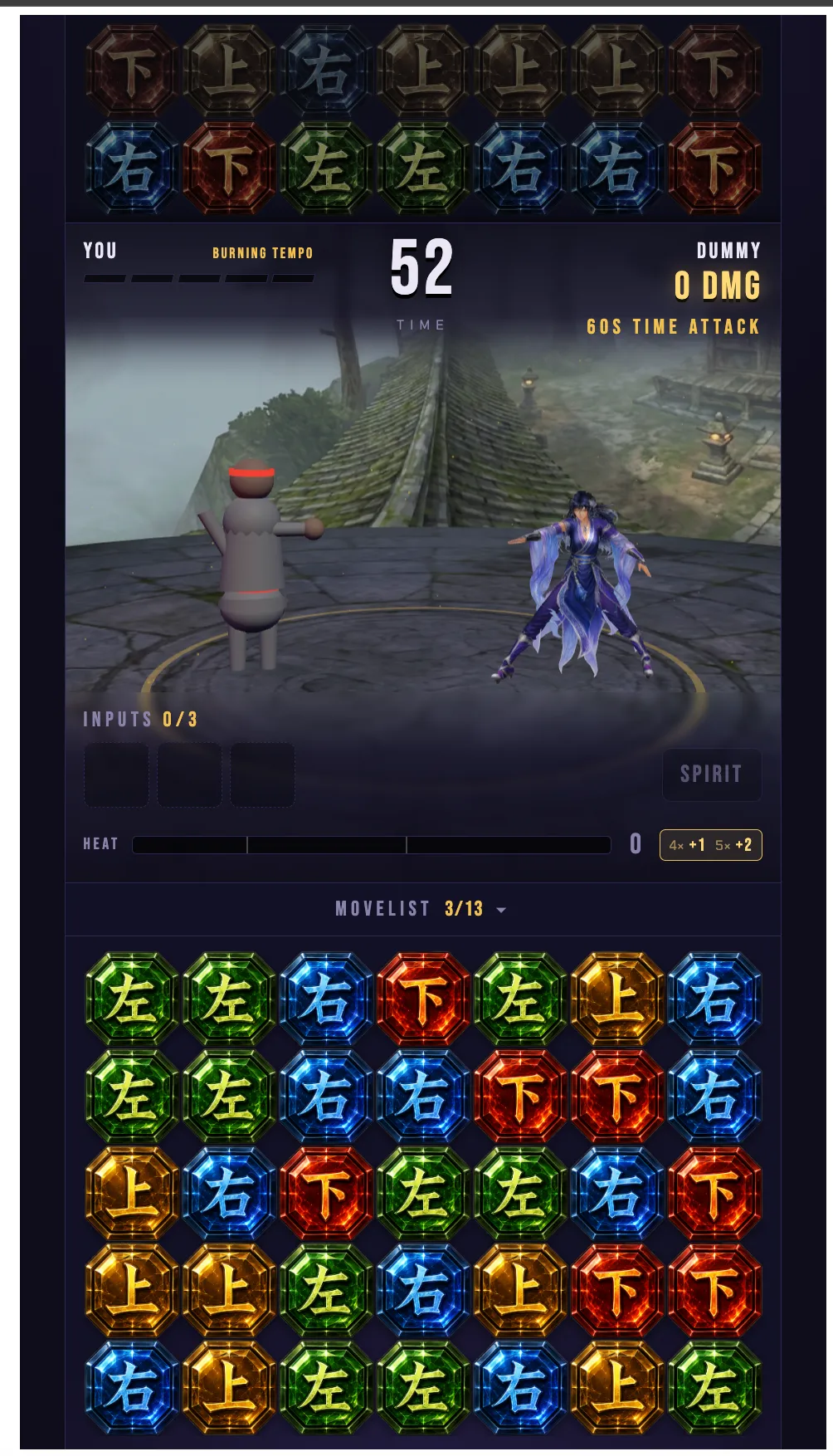
The current prototype, in all its programmer-art glory. Those tiles are 上/下/左/右 — up, down, left, right — the four directional inputs. Match three, and they feed the input queue at the center. The purple fighter is stand-in art; the gray blob is my long-suffering training dummy.
Now, as soon as I did this, I also realized that by combining action and puzzle genres, I now have a completely new surface I can inject the satisfaction of games into. Historically, match-3 games juice their gameplay by giving 4x/5x/T-shaped/L-shaped matches explosive effects. In Candy Crush, achieving any of the above matches has the potential to combo into screen-wiping effects that tickle even the most “hardcore” of gamers’ brains. In Legaia, when you input a special move’s sequence, the attack you get is a unique arts-specific animation with accompanying cinematic camera perspective and audio engineering that would make a movie theater jealous. For my game, I’m theorizing that the cinematic martial arts angle will be just as satisfying of a payoff as watching scores of candies get crushed - but that’s proving more difficult than initially thought. Stay tuned to hear how I’m navigating the challenges!
Over the next several weeks, I’m going to be building Zanshin: Blade & Tile as far as I can into a respectable mobile game. I’ll be posting little tidbits about my development journey and the twists and turns it’ll no doubt have (already have hit quite a few). Of course I’ll also be looking for feedback, ideas, and playtesters, so leave a comment, like, subscribe, you know how it works. Hope to see you at 1.0.0!